
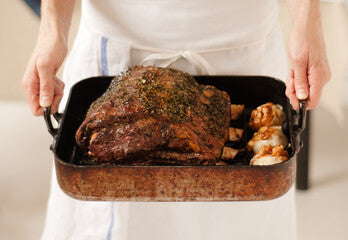
It is often assumed that bones impart flavor to meat during cooking. In reality, with the short cooking time of a steak, no significant flavor exchange occurs between the bone and muscle tissue. The bone consists primarily of mineralized structure (calcium phosphate), collagen, and bone marrow – flavor compounds do not measurably transfer into the meat during the brief period of pan-frying or grilling.
However, the bone acts physically as an insulator. It conducts heat significantly slower than muscle tissue, so the meat in its immediate vicinity cooks more slowly. This often creates a small area that remains juicier and slightly less cooked. This effect can positively influence the eating experience – not because of additional flavors, but due to the altered heat distribution.
The origin of the myth likely lies in traditional soup and sauce making. During the long simmering of bones – for stocks or broths, for example – flavor compounds, gelatin, and bone marrow do indeed dissolve. Classics like French "fond de veau" or rich beef broths are based precisely on this principle. Over hours, flavor compounds diffuse into the water. However, this slow extraction is mistakenly transferred to the pan-frying of a chop or T-bone steak, which lasts only a few minutes.
Historically, bone-in cuts also had a practical advantage: they were easier to position and turn over an open fire. In grilling culture – especially with cuts like porterhouse or bone-in rib-eye – the bone became a symbol of authenticity and quality. Visual appeal and haptics reinforced the perception of a "more intense" flavor.
Interestingly, bone marrow can indeed slightly melt and seep out at the cut surface during very long grilling or oven cooking. If this marrow is eaten along with the meat, it naturally contributes to the taste – but not through migration into the meat, rather through direct consumption.
Today, we know: the bone does not impart additional flavor to the steak by releasing it into the muscle tissue. Its influence is thermal in nature – and not least, aesthetic. Flavor primarily results from meat quality, aging, marbling, and the Maillard reaction on the surface, not from the bone itself.


