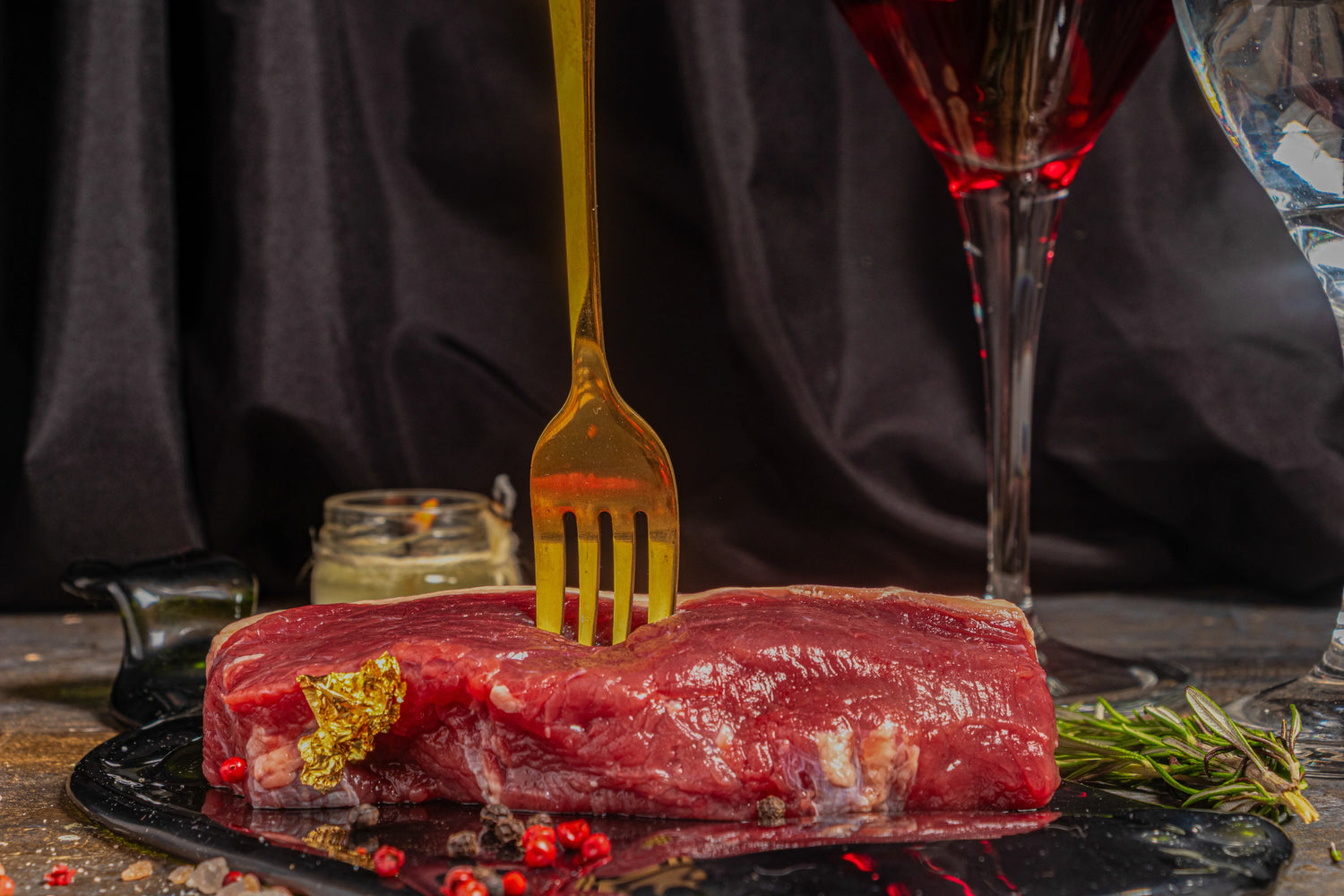
The idea that a single stab with a fork leads to a "juice catastrophe" is greatly exaggerated. A steak consists of thousands of fine muscle fibers that do not store liquid like a water balloon but bind it in a complex protein structure.
A few stabs or a small incision for doneness testing cause only negligible fluid loss and have no decisive influence on juiciness. Even if some meat juice escapes at one point, this affects only a tiny part of the overall structure.
The myth probably arose from the observation that visible juice escapes when cutting into it – which was quickly interpreted as "loss." In reality, this is primarily water that is squeezed out of denaturing proteins by heat. However, the majority of juiciness depends on factors such as core temperature, marbling, and resting period, not on individual punctures.
Historically, the warning against "piercing" can be traced back to 19th-century classical French culinary teaching. In professional kitchens, it was considered a sign of artisanal precision to turn meat exclusively with tongs – not least for aesthetic reasons. The image of the "uninjured" steak became a mark of quality and evolved over time into a fixed rule. However, with the advent of scientific considerations of cooking processes in the 20th century – particularly by authors such as Harold McGee – it became clear that the amount of juice released by individual punctures is measurable but minimal.
However, there is a difference with very thin cuts of meat or ground meat products, where structure and fluid binding work differently. Thin steaks or minute steaks have less overall volume and cook very quickly. Here, a puncture can allow slightly more juice to escape because the heated zone occupies a larger proportion of the total piece. While the effect remains moderate, it is more noticeable than with a thick cut.
With ground meat, the situation is different again: The natural muscle fiber structure is already destroyed by mincing. Liquid and fat are less stably bound and distribute unevenly. If a burger patty is repeatedly pricked or pressed with pressure, not only water but especially melted fat can escape – and it is precisely this fat that significantly contributes to juiciness and mouthfeel. Therefore, it is actually recommended not to pierce burgers with a fork and not to press them unnecessarily.
However, fluid loss is almost always decisively greater due to overcooking: If the core temperature rises too much, the muscle fibers contract and squeeze out significantly more liquid than a fork could ever cause.
Today, therefore, the rule is: working with a fork does not automatically ruin juiciness – temperature control, resting time, cutting thickness, and meat quality are decisive.


