
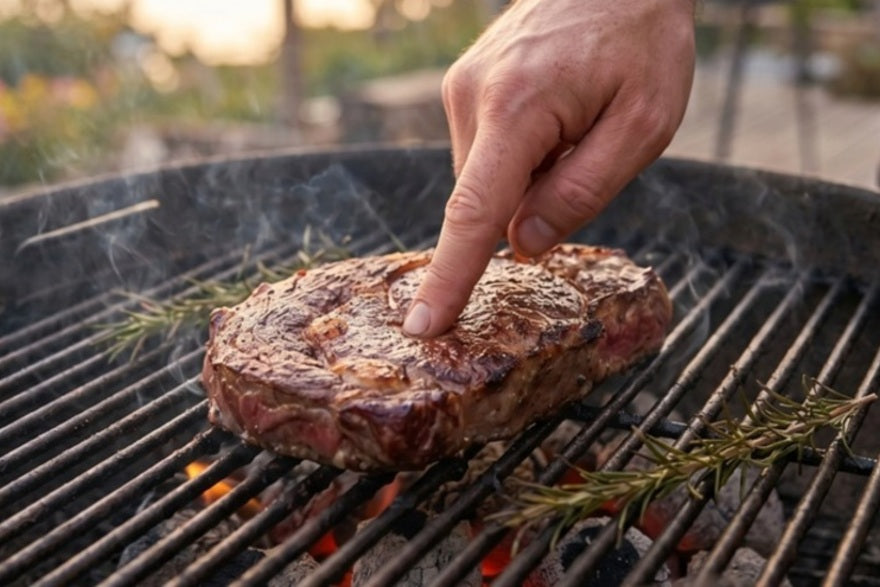
Many swear by determining doneness by pressing with a finger. However, this method is extremely imprecise, as every hand presses with a different amount of force and every piece of meat has different characteristics. Factors such as thickness, marbling, maturity, and initial temperature significantly influence elasticity – two visually identical steaks can feel completely different.
The so-called "pressure test" – often combined with the well-known "thumb pad comparison" – became widespread primarily in 20th-century steakhouse and grilling culture. In professional kitchens, it was long a pragmatic tool because thermometers were slow to react, large, or only used at the end of the cooking process. Fast work at the pass often left no room for measuring instruments.
Historically, determining doneness by touch is much older. Even in pre-industrial kitchens, meat was assessed by feel and observation – due to a lack of technical alternatives. Only with the development of precise temperature measuring devices in the 19th century, in the course of industrialization and advances in thermodynamics, did it become possible to reliably measure core temperatures. Nevertheless, the pressure test persisted as a sign of craftsmanship and "Fingerspitzengefühl" (instinctive feel).
However, modern food science clearly shows: doneness is a matter of core temperature. The denaturation of proteins such as myosin begins as early as 40–50 °C, while actin is structurally altered only at higher temperatures. These processes can be objectively measured, but not precisely felt by touch.
For precise results, therefore, an instant-read meat thermometer should be used, as it provides reproducible values and makes the cooking process controllable – especially for thick cuts or high-quality pieces. However, for those who do not own a thermometer, the pressure test can certainly be used as a rough guide. With some experience, one can at least distinguish whether a steak is still very soft (rare), elastic and springy (medium), or significantly firmer (well done). While it does not replace an exact measurement, it is a practical emergency solution.
Today, the rule is: feel can assist – but temperature decides.


